
peak girlhood
a mark of lived experience, a residue of intimacy that contradicts performativity.

At the brunch table, sat glasses faint stained with lipstick smudges. That rebellious trace captures a fleeting moment of imperfection and intimacy. Its a small but potent symbol, the remnants of a girl’s ritual, where girlhood is performed and celebrated.
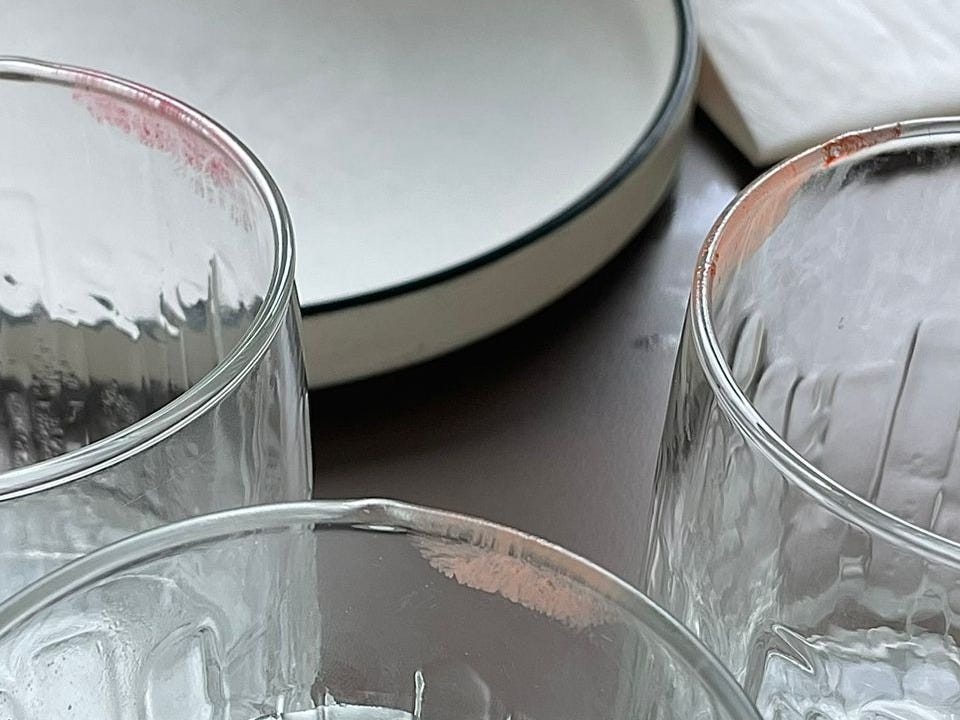
The image attached is so seemingly mundane, embracing an emblem of the social and personal spaces where girlhood is enacted, resonating deeply within contemporary cultural narratives on identity, youth, and femininity. “Peak girlhood”, a phrase used for it’s vibrant self-expression, aesthetic exploration, and the boundary between curated perfection and unapologetic vulnerability.
This column aims to speak on the multifaceted significance of this act, and place it within broader feminist, and psychoanalytic discourses. With that, I demonstrate how the lipstick smudge represent the complex and contradictory nature of girlhood, a space for vulnerability and performativity. Essentially, explore how this mundane image functions as a visual symbol for contemporary girlhood drawing from cultural studies, feminist theory, psychoanalysis.
The iconography of girlhood has long existed, through lipstick being a powerful emblem within cultural lexicon of femininity. The history goes way back, returning centuries, serving as a token of social status, rebellion, or conformity. Stated in history, red lipstick was adopted as a symbol of strength and defiance in their fights for women’s rights (Ware, 2020). Some use it as a tool for liberation, others for seduction. At present, lipstick continues to serve as a performative act, or a ritual adopted by girls and women to portray identity.
Applying lipstick is often an act of self-care, ritualistic and a bold gesture of social cues. As El Jurdi and Smith (2018) argues that beauty ideals are tied to global media and cultural narratives where women (and increasingly men) use practice beauty beyond self-care, signaling belonging, identity, and status. However, these beauty are not neutral, and attached to unrealistic, shifting, Westernized standards. This often reinforces gendered and consumerist pressures.
In this specific context, the glass at brunch becomes a canvas (of some sort), where the stain or smudge represents the act of drinking, socializing, and applying makeup merge together. It intertwines the performativity of girlhood with raw, genuine expressions, highlighting imperfections.
The lipstick stain on the glass is an intuitive symbol, an imprint of human flaw that counters the ideals of beauty. As Judith Butler (1990) argues that gender is heavily performative through repeated set of acts and gestures. Similarly in this case, the smudge lipstick embodies this performativity, depicting femininity as a flexible and shifting force.
In girlhood, imperfection becomes a domain of defiance. If one reflects on it, embracing flaw and vulnerability can serve as acts of resistance or rebellion against oppressive beauty standards. The smudge is a visual representation of refusal to submit to feminine ideals.
In a psychoanalytic lens, Julia Kristeva’s (1980) principle of abjection, explores the emotional resonance of the smudge. Abjection involves the feeling of disgust when confronted with what is considered taboo or disturbing. In this case, the lipstick smudge disrupts the polished surface of the glass, directly exposing the raw reality of human imprint. It evokes that girlhood is about accepting one’s flaws, blemishes, and defects.
In an era of curated and polished images, the smudge is also a mark of lived experience, a residue of intimacy that contradicts performativity. Becoming a symbol of sincere girlhood, be it messy, imperfect, actual.
Girlhood is a fluid performance constantly shaping cultural scripts and personal identity. The act of reapplying lipstick, social gathering of brunch, and the unplanned, accidental smudge are all performative acts that construct girlhood’s adaptable identity. The smudge disrupts the neat and tidily script of femininity, revealing the subtle tension between societal expectations and embodied authenticity. The ritual at brunch depicts the cultural space where girlhood is performed, but the subtle, overlooked smudge illustrates where the performativity slips, revealing the imperfect and raw body beneath.